Wednesday, January 30, 2013

Thanks Oprah, now so have I...


Tell us the title:
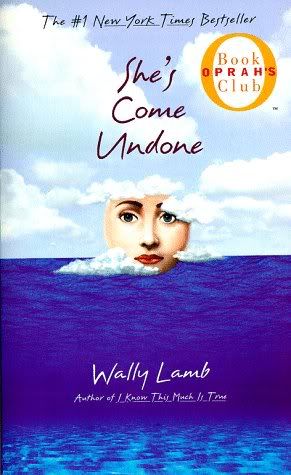
She's Come Undone

Who penned this work?:
Wally Lamb

How did this piece find it's way to your nightstand?:
I think I saw it recommended in a magazine and then found it at the library

Number of pages:
465

Time passed from start to finish?:
A week or two

Describe the cover:


In what section of the bookstore would a reader find this?:
Fiction

Summary of the basic plot:
The story follows the journey of a girl from childhood into adulthood.  Along the way, she encounters many heartbreaking an traumatic situations.  I could go into more detail than that, but there's a summary.

What did you think of it? (your general response, what you liked or didn't like, what you learned, anything else you want to share about it):
I felt about the same emotional overwhelm while reading this as I felt watching the movie Rachel Getting Married.  It totally stressed me out.  Interestingly enough, I was more impacted by contemplating my stress over this than I was by the story itself. 

Which page was your favorite? Share why:
Probably the pages with the whales.  That would be the one in the middle of the story because it felt like a transforming moment.  And at the end of the book because it was nice and then it was over.

If the story was made into a movie, who would you cast as the main characters?
No idea.
Share a quote that was worth reading twice. Explain why:
Ummmm...I just spent ten minutes trying to figure this out and I do not know.
I shall continue working on this question.


Choose your rating:
 - Changed. My. Life.
     - I laughed, I cried, I want you to read it
    - A definite page-turner
Somewhere Between...
    - Good to check out but don't spend the cash.
and
      - Why did I waste my weekend on this?
     - A disgrace to paper everywhere

Flip to page 2, 22, or 202. Share the 7th sentence on the page. 
"You know anything about tropical fish?"

Thursday, January 3, 2013

Family Drama


Tell us the title:
Maine

Who penned this work?:
J. Courtney Sullivan

How did this piece find it's way to your nightstand?:
It was given to me by my mother-in-law

Number of pages:
509

Time passed from start to finish?:
a couple weeks, as i mostly only read it on my lunch breaks at work

Describe the cover:


girl relaxing on beach looking off into distance

In what section of the bookstore would a reader find this?:
fiction

Summary of the basic plot:
Revolves around four women, a grandmother, her daughter, her granddaughter, and her daughter-in-law. They are an Irish Catholic family, most of the story takes place at the grandmother's beach house in Maine. It is mostly about the interactions of these four very different women and their lives separately, and together.

Background information on the story/author:
I know she's written another best seller called "commencement" and that she lives in NYC, but not much else.

What did you think of it? (your general response, what you liked or didn't like, what you learned, anything else you want to share about it):
I enjoyed it.  Although I thought it was funny that my mother-in-law recommended it to me, because they are an irish catholic family and she said it reminded her of her family, and i wondered the whole time "who is she thinking of when she's reading this character?" i didn't care much for the ending, honestly, it seemed to wrap up way too quickly (hard to believe at 509 pages, but i could have used a bit more explanations).

Which page was your favorite? Share why:
ok well i don't have a favorite page but my favorite quote was: "perhaps she underestimated him. He seemed friendly and genuine, though she reminded herself that now would be an especially inconvenient time to fall in love with a Catholic priest."

If the story was made into a movie, who would you cast as the main characters?
hmm....helen mirren as Alice, jennifer garner as Ann Marie, julia roberts as Kathleen, maybe elizabeth olsen as Maggie, but maybe a little too young.

Share a quote that was worth reading twice. Explain why:
ok i already put my favorite funny quote, good enough!

Choose your rating:Changed. My. Life.
I laughed, I cried, I want you to read it
A definite page-turner
Good to check out but don't spend the cash.
Why did I waste my weekend on this?
A disgrace to paper everywhere

Flip to page 2, 22, or 202. Share the 7th sentence on the page. 
"at her first penance at age seven, Maggie had grown so terrified that she blanked on her prepared list of sins (she stole some of chris's halloween candy, she talked back to her mother)." not the best quote, but best out of the three pages!

Friday, November 30, 2012

Can I read it again now??


Tell us the title:
Sarah's Key

Who penned this work?:
Tatiana de Rosnay

How did this piece find it's way to your nightstand?:
My mother-in-law lent it to me

Number of pages:
293

Time passed from start to finish?:
three or four days

Describe the cover:
Two small kids running down a road in Paris

In what section of the bookstore would a reader find this?:
Fiction, but based on real-life events

Summary of the basic plot:
Paris, July 1942: Sarah, a ten year-old girl, is brutally arrested with her family by the French police in the Vel’ d’Hiv’ roundup, but not before she locks her younger brother in a cupboard in the family's apartment, thinking that she will be back within a few hours. 

Paris, May 2002: On Vel’ d’Hiv’s 60th anniversary, journalist Julia Jarmond is asked to write an article about this black day in France's past. Through her contemporary investigation, she stumbles onto a trail of long-hidden family secrets that connect her to Sarah. Julia finds herself compelled to retrace the girl's ordeal, from that terrible term in the Vel d'Hiv', to the camps, and beyond. As she probes into Sarah's past, she begins to question her own place in France, and to reevaluate her marriage and her life. 

What did you think of it? (your general response, what you liked or didn't like, what you learned, anything else you want to share about it):
Couldn't put it down, it was very interesting to learn about something that I had no clue that had happened.

Which page was your favorite? Share why:
gah, i don't know

If the story was made into a movie, who would you cast as the main characters?
well upon searching for a quick summary, i discovered that it has already been made into a movie. most of the characters are french though, so i wouldn't know who to cast!

Share a quote that was worth reading twice. Explain why:
It's more of a section: "The girl wondered: these policemen...didn't they have families too? Didn't they have children? Children they went home to? How could they treat children this way? Were they told to do so, or did they act this way naturally? Were they in fact machines, not human beings? She looked closely at them.  They seemed of flesh and bone.  They were men.  She couldn't understand."

When reading, you can really feel like you are there with her, and feeling everything she's feeling and thinking.  It was just a horrible time, and i can't imagine what it was like for them.

Choose your rating:
          - Changed. My. Life.
          - I laughed, I cried, I want you to read it
          - A definite page-turner
          - Good to check out but don't spend the cash.
          - Why did I waste my weekend on this?
          - A disgrace to paper everywhere

Flip to page 2, 22, or 202. Share the 7th sentence on the page. 
"Was that why they were here, had the police come to take Papa to the places he had mentioned during those hushed midnight talks: the "camps," far away, out of the city?"

Sunday, September 23, 2012

Tell us the title:
Cutting for Stone

Who penned this work?:
Abraham Verghese

How did this piece find it's way to your nightstand?:
A coworker recommended this story, and lent it to me.

Number of pages:
658

Time passed from start to finish?:
About a week

Describe the cover:

In what section of the bookstore would a reader find this?:
Fiction

Summary of the basic plot:
"Marion and Shiva Stone are twin brothers born of a secret union between a beautiful Indian nun and a brash British surgeon.  Orphaned by their mother's death and their father's disappearance, bound together by a preternatural connection and a shared fascination with medicine, the twins come of age as Ethiopia hovers on the brink of revolution.  Moving from Addis Ababa to New York City and back again, Cutting for Stone is an unforgettable story of love and betrayal, medicine and ordinary miracles -- and two brothers whose fates are forever intertwined." (from back cover)

What did you think of it? (your general response, what you liked or didn't like, what you learned, anything else you want to share about it):
At first I dragged my feet on opening this book and starting it.  It didn't sound interesting to me, and I don't typically read fiction stories that are about real life.  A few chapters in, however, and I found myself hooked.  I had to keep reminding myself that this was in fact fiction, as it seemed so real and so possible.  A captivating story combined with beautiful writing made for quite a journey.

Which page was your favorite? Share why:
I would say that my favorite page was the first one with a quote that stopped me in my tracks: "Her skills were so rare, so needed for the poorest of the poor, and even at times in the royal palace, that she felt valued.  Wasn't that the definition of home?  Not where you are from, but where you are wanted?"

If the story was made into a movie, who would you cast as the main characters?
I don't even have the remotest clue.  I do hope that it is made into a movie, though!

Share a quote that was worth reading twice. Explain why:
Where do I begin?
Page 141: "Ignorance was just as dynamic as knowledge, and it grew in the same proportion.  Still, each generation of physicians imagined that ignorance was the special provenance of their elders."
Page 236: "I stood firm.  I didn't trust Hema's motivation: guilt leads to righteous action, but rarely is the the right action.  Besides, I had planned a special parade of my Dinky Toys in a weaving path I had carved out on a low embankment next to the house.  Her timing was terrible."  (this made me laugh out loud, and remember once when I wrote in my diary how upset I was that my own mother had thrown out some candy wrappers I had been saving.  Oh, the dramas of childhood...)
Page 332: "I knew what I'd say to him: You're much too late.  We went ahead with our lives without you."  (this one struck me for personal reasons)
Page 351: "In order to start to get rid of your slippers, you have to admit they are yours, and if you do, then they will get rid of themselves...I hope one day you see this as clearly as I did...The key to your happiness is to own your slippers, own who you are, own how you look, own your family, own the talents you have, own the ones you don't.  If you keep saying your slippers aren't yours, then you'll die searching, you'll die bitter, always feeling you were promised more.  Not only our actions, but also our omissions, become our destiny."
Page 434: "My VIP patients often regret so many things on their deathbeds.  They regret the bitterness they'll leave in people's hearts.  They realize that no money, no church service, no eulogy, no funeral procession no matter how elaborate, can remove the legacy of a mean spirit."

Choose your rating:
         
 - Changed. My. Life.
          - I laughed, I cried, I want you to read it
          
- A definite page-turner
          - Good to check out but don't spend the cash.
          - Why did I waste my weekend on this?
          - A disgrace to paper everywhere

Flip to page 2, 22, or 202. Share the 7th sentence on the page. 
 "At that moment, though none of them quite realized it, Missing officially reopened for business."

Sunday, July 1, 2012

As soldiers really live it

Tell us the title:
War
Who penned this work?:
Sebastian Junger
How did this piece find it's way to your nightstand?:
This book was given to me for free at a library convention as an advance reading copy.  Which I did not read until long after the book was officially published.
Number of pages:
268
Time passed from start to finish?:
About 4 days
Describe the cover:

In what section of the bookstore would a reader find this?:
Nonfiction, Current Events
Summary of the basic plot:
This story follows a single platoon in the most dangerous valley in Afghanistan during their 15-month deployment.
Background information on the story/author:
Sebastian Junger is a journalist who also wrote The Perfect Storm.
What did you think of it? (your general response, what you liked or didn't like, what you learned, anything else you want to share about it):
This was nothing like what I expected.  I put off reading this again and again because I didn't think it would be interesting.  When I actually began reading, I was sucked in for days.  I became attached to all of the soldiers, and my mind strained to pretend this was fiction when people died.  It was a different experience than any I've had with nonfiction books.  After I finished, someone told me about the documentary about the same men (created by the author) -- called Restrepo.  I then watched that one afternoon.  It was very compelling, as I already knew the stories of the men, and I was putting faces to names, making it that much more in your face.  These are real men, not characters in a story. 
Which page was your favorite? Share why:
I don't know that I would call any of the pages "favorites," but I did find it very interesting when Junger discussed the biology of war.  He talks about what occurs in your body during war-time experiences such as firefights and attacks, and how those biological responses sometimes produce the opposite effect of what you need to be doing, bringing in the element of self-control.  He discusses what makes men good soldiers, how much of that is innate.  He also talks about how war is so much different now than it was historically, and how we have not evolved to survive automatic weapons (our reactions times cannot respond faster than bullets can fly). 
If the story was made into a movie, who would you cast as the main characters?
This story can never effectively be a cinematic movie with people pretending to be these men. I recommend watching Restrepo.
Share a quote that was worth reading twice. Explain why:
(Pretty self-explanatory, I feel):
"Civilians balk at recognizing that one of the most traumatic things about combat is having to give it up.  War is so obviously evil and wrong that the idea there could be anything good to it almost feels like a profanity.  And yet throughout history, men like Mac and Rice and O'Byrne have come home to find themselves desperately missing what should have been the worst experience of their lives.  To a combat vet, the civilian world can seem frivolous and dull, with very little at stake and all the wrong people in power.  These men come home and quickly find themselves getting berated by a rear-base major who's never seen combat or arguing with their girlfriend about some domestic issue they don't even understand.  When men say they miss combat, it's not that they actually miss getting shot at -- you'd have to be deranged -- it's that they miss being in a world where everything is important and nothing is taken for granted.  They miss being in a world where human relations are entirely governed by whether you can trust the other person with your life. 
It's such a pure, clean standard that men can completely remake themselves in war.  You could be anything back home -- shy, ugly, rich, poor, unpopular -- and it won't matter because it's of no consequence in a firefight, and therefore of no consequence, period."
Choose your rating:
Changed. My. Life.
I laughed, I cried, I want you to read it
A definite page-turner
Good to check out but don't spend the cash.
Why did I waste my weekend on this?
A disgrace to paper everywhere
Flip to page 2, 22, or 202. Share the 7th sentence on the page. 
"Toward the end of their tour they'd go through entire firefights in nothing but gym shorts and unlaced boots, cigarettes hanging out of their lips."

It Takes A Graveyard To Raise A Child

Tell us the title: 
The Graveyard Book
Who penned this work?: 
Neil Gaiman.  You're shocked, I know. 
How did this piece find it's way to your nightstand?: 
Powell's had it on sale, and I figured it was time to move on to his children's books
Number of pages: 
313
Time passed from start to finish?: 
2 days
Describe the cover:
 
In what section of the bookstore would a reader find this?:
Children's fiction, Powell's best sellers shelf (even though it was published in 2008)
Summary of the basic plot:
(from the back cover): "Nobody Owens, known as Bod, is a normal boy.  He would be completely normal if he didn't live in a graveyard, being raised by ghosts, with a guardian who belongs to neither the world of the living nor the dead.  There are adventures in the graveyard for a boy -- an ancient Indigo Man, a gateway to the abandoned city of ghouls, the strange and terrible Sleer.  But if Bod leaves the graveyard, he will be in danger from the man Jack -- who has already killed Bod's family.
Background information on the story/author:
Neil Gaiman will be the favorite author of my personal lifetime.  Please consider reading everything he has ever written.  Also, The Graveyard Book has won both the Newbery (US) and Carnegie (UK) medals. 
What did you think of it? (your general response, what you liked or didn't like, what you learned, anything else you want to share about it):
Only in Neil Gaiman's world can a story be so dark yet make you laugh hysterically and walk away at the end a better person for the lessons you have learned.  This is the first of his stories I've read that contains illustrations...and I'm not sure how I felt about it.  The illustrations are wonderfully done, but I didn't love the way they altered the images I had created in my head.  This may be a good stepping stone into his graphic novels.
Which page was your favorite? Share why:
Page 206, where Mistress Owens finishes the last lines of her song, one tale ends, and many others begin.
If the story was made into a movie, who would you cast as the main characters?
My brain cannot even begin to fathom that.  I can only see the characters in my head, and no actors can do those justice.
Share a quote that was worth reading twice. Explain why:
(from page 70, for the reason that it made me laugh hysterically): 
"Name the different kinds of people," said Miss Lupescu.  "Now."
Bod thought for a moment.  "The living," he said.  "Er.  The dead."  He stopped.  Then, ". . .Cats?" he offered, uncertainly.
Choose your rating:
Changed. My. Life. 
I laughed, I cried, I want you to read it
A definite page-turner
Good to check out but don't spend the cash.
Why did I waste my weekend on this?
A disgrace to paper everywhere

Flip to page 2, 22, or 202. Share the 7th sentence on the page. 
"A screech of brakes as the car stopped, and the ginger policeman began to swear under his breath."

Sunday, June 10, 2012

“…the harsh conformity of high-school cliques and one teen’s struggle to find acceptance…."


Tell us the title:
Speak
 
Who penned this work?:
Laurie Halse Anderson

How did this piece find it's way to your nightstand?:
I first read it in high school, and when I found it on Laura’s bookshelf, I was drawn to read it again.

Number of pages:
198, unless you count the Q&A with the author at the end which would make it 202 :) 

Time passed from start to finish?:
Less than a day…what can I say, it sucks you in.

Describe the cover:
Two soulful, somewhat detached, sorrow-filled eyes stare out from behind a sparsely leaved tree branch

In what section of the bookstore would a reader find this?:
Young Adult, Coming of Age, Fiction

Summary of the basic plot:
From the back: "Melinda Sordino busted an end-of-summer party by calling the cops, so her old friends won’t talk to her, and people she doesn’t know hate her from a distance.  The safest place to be is alone, inside her own head."

Background information on the story/author:
Laurie Halse Anderson is the author of the award-winning Fever 1793 and Catalyst, as well as five picture books.  She lives outside of Philadelphia, PA, and has two teenage daughters. Visit her website at: madwomanintheforest.com  

What did you think of it? (your general response, what you liked or didn't like, what you learned, anything else you want to share about it):
I loved it in the way that I love anything that pushes me to the edge of an emotional precipice and forces me to think and feel beyond myself and connect to a larger picture.  This book takes you to the brink and leaves you clinging (along with Melinda) to whatever flimsy reality your fingers can grasp in order to maintain a sense of sanity and self – even if that means shutting everyone else out.  Anderson has a knack for causing her reader to delve deeply into the world of her characters, to feel what they feel and think their thoughts.  I love the way Halse uses art within her novel as a way to provide a voice to the main character, giving her a way to speak without saying a word.  Also, it reminded me that while I’ve had some “bad apples” throughout my life as far as teachers go, I’ve also had those few, rare instructors who teach beyond the page and really connect with their students.

Which page was your favorite? Share why:
There are lots of pages that I could put here: the one where David stands up to Mr. Neck, or the one where Mr. Freeman encourages Melinda breathe life into her art, or the one where Melinda asks her dad to buy her some seeds, but some of my absolute favorite are at the end where Melinda is finally able to fully speak her story.

Share a quote that was worth reading twice. Explain why:

 
“Mr. Freeman: ‘You are getting better at this, but it’s not good enough.  This looks like a tree, but it is an average, ordinary, everyday, boring tree.  Breathe life into it. Make it bend—trees are flexible, so they don’t snap.  Scar it, give it a twisted branch—perfect trees don’t exist.  Nothing is perfect.  Flaws are interesting.  Be the tree.”
I think this is pretty self-explanatory.


Choose your rating:
- Changed. My. Life.
- I laughed, I cried, I want you to read it 

- A definite page-turner
 - Good to check out but don't spend the cash.
 - Why did I waste my weekend on this?
 - A disgrace to paper everywhere

Flip to page 2, 22, or 202. Share the 7th sentence on the page:
Page 22 – “Just so I don’t feel and look so stupid.”

Sunday, March 11, 2012

"A comedy of ill-mannered gods and bad-hearted mortals..."

Tell us the title:
Anansi Boys
 
Who penned this work?:
Neil Gaiman

How did this piece find it's way to your nightstand?:
Anything with Neil Gaiman's name on it will eventually find its way onto my reading list.  Pretty sure I've read all the adult-aimed novels now.  I was holding on to this one, saving it for a lull in my passion for reading, for I knew it would spark me back up!

Number of pages:
400, if I get to count the excerpt from another book at the end, which I have already read but of course read again. 

Time passed from start to finish?:
Since I had to go to work during the week....about a week.  AKA about a day and a half.

Describe the cover:
Three men's shadows appear against a red-orange sky, with spider web cast about the background.  One man appears to have a lovely umbrella.

In what section of the bookstore would a reader find this?:
For reasons I may never actually understand, science fiction.  I guess since there's not a section called "best stuff ever".

Summary of the basic plot:
From the back: "Far Charlie Nancy's normal life ended the moment his father dropped dead on a Florida karaoke stage.  Charlie didn't know his dad was a god.  And he never knew he had a brother..."

Background information on the story/author:
Neil Gaiman is the best writer ever.  Done.

What did you think of it? (your general response, what you liked or didn't like, what you learned, anything else you want to share about it):
I loved it, just like I love every story by Neil Gaiman.  If you're hoping to fall in love with his stories, I'm not sure I would start with this one, but if you're already convinced of his awesomeness, read on, my friend.  As always, a tale is weaved (woven?) when you're not even looking, and those pesky little life lessons pop out at the end in ridiculously non-obvious-yet-completely-apparent ways.

Which page was your favorite? Share why:
Apparently I didn't mark such a page, so I can't give a number...although that would be a bit of a spoiler for anyone who wanted to read ahead anyway.  My favorite page was when Fat Charlie finally realized the truth about his brother.  And that statement is exactly as cryptic as I wanted it to be.

Share a quote that was worth reading twice. Explain why:

 For once not a funny one:
"Each person who ever was or is or will be has a song.  It isn't a song that anybody else wrote.  It has its own melody, it has its own words.  Very few people get to sing their own song.  Most of us fear that we cannot do it justice with our voices, or that our words are too foolish or too honest, or too odd.  So people live their songs instead."


Choose your rating:

- Changed. My. Life.
- I laughed, I cried, I want you to read it 
- A definite page-turner
 - Good to check out but don't spend the cash.
 - Why did I waste my weekend on this?
 - A disgrace to paper everywhere

Flip to page 2, 22, or 202. Share the 7th sentence on the page:
"Only..."

Friday, February 3, 2012

The Secret Garden OR A Guide to Building a Family

~ Tell us the title: The Secret Garden
~ Who penned this work?: Francis Hodgson Burnett
~ How did this piece find it's way to your nightstand?: It was my Grandmother's favorite book.  I felt a great connection to her by reading it and could easily place her as one of the characters in the book.
~ Number of pages: 234
~ Time passed from start to finish?: Don't remember. It didn't take long.
~ Describe the cover: A young girl (Mary Lennox) stooping in front of an ivy-covered wall, inserting a key into a lock.
~ In what section of the bookstore would a reader find this?: Classics Maybe?
~ Summary of the basic plot: Mary's a spoiled rotten brat forced to move into her uncle's house when her parents die of cholera.  What unfolds is an unexpected welcoming of love and care from a family that is not her own (aka - not her uncle).
~ Background information on the story/author:  Hodgson Burnett was a woman born in England than started writing for journal publications to help her family make money.  Her writing earned her money and later fame as she moved to writing novels.
~ What did you think of it? (your general response, what you liked or didn't like, what you learned, anything else you want to share about it):  I loved it.  Even though its target is children, its still a novel with lessons and themes that can be applied at any stage in life.  The reading flowed smoothly and lacked slow moments and extraneous details.
~ Choose your rating:
          - Changed. My. Life. It really was a great connection to my grandmother and helped me reconcile her passing.  She was a fantastic woman that treated everyone as family and her love and companionship will always be missed.
          - I laughed, I cried, I want you to read it
          - A definite page-turner
          - Good to check out but don't spend the cash.
          - Why did I waste my weekend on this?
          - A disgrace to paper everywhere

Monday, January 23, 2012

True Crime, Nothing More

~ Tell us the title: Serial Murder 101
~ Who penned this work?: Bridget DiCosmo
~ How did this piece find it's way to your nightstand?: Borders went out of business, I got it for 60% off I think.  There was probably a reason it was still on the shelf.
~ Number of pages: 294
~ Time passed from start to finish?: 10 daysish
~ Describe the cover: Two pictures of Krajcir, a man that reminds me of Dr. Death, perhaps fitting;  There are also three pictures that I'm guessing belong to victims of his.
~ In what section of the bookstore would a reader find this?:  True Crime
~ Summary of the basic plot:  Timothy Krajcir (I don't know how to say that either) was a serial killer that went out with a whimper.  This book follows his escapades in a very matter-of-fact manner while attempting to draw personal connections within the story and to the reader.
~ Background information on the story/author: Krajcir is/was (don't care if he's still alive) a rapist and murderer.  And, from the back page, "Bridget DiCosmo is an award-winning crime reporter for the Southeast Missourian, a daily newspaper in Cape Girardeau, Missouri.  She pursued a graduate education at Point Park University in Pittsburgh, Pennsylvania, and holds an undergraduate degree in history from St. John's University in Queens, New York.  When she is not digging into the world of crime, Bridget relaxes by riding horses and spending time at home with Bandit, her King Charles spanieal, and Natalie, her cat."
~ What did you think of it? (your general response, what you liked or didn't like, what you learned, anything else you want to share about it):  I felt like the whole thing was a long, drawn out bore of a story.  I love true crime, which is likely the only reason I was able to finish this book.  On numerous occasions I found myself frustrated by repetitive metaphors and elaborate descriptions of simple events.  It reminds me of the writing in A Date with Death, which I'm working on reviewing currently.  Coincidentally (or not so much) both DiCosmo and A Date with Death's  author are reporters.  The tie between them seems to explain the struggles they both had in creatively telling a true story.  If you're writing a paper article, you've got three lines to express three paragraphs.  In Serial Murder 101, DiCosmo fails to increase the juicy details of the story, while expanding on the three line articles she writes day-to-day.  Furthermore, any personal connection misses wildly while over-emphasis on certain "connections/coincidences" runs rampant.  

     Overall, it was a frustrating read.
~ Which page was your favorite? Share why:  I made it through the whole book without a single dog-eared page, so I'm not sure I was intrigued much.  However, I did find it interesting that someone was convicted and died while in prison for "committing" one of the crimes that Krajcir confessed to committing.
~ If the story was made into a movie, who would you cast as the main characters?  I wouldn't make a movie out of it, there was nothing spectacular about it.
~ Share a quote that was worth reading twice. Explain why: "The current Mount Vernon police chief suggested that the confession was a phony and should cast serious doubt on Krajcir's credibility" (pg. 287)  Very interesting that a police official, whom the public trusts, is unwilling to even consider they may have made a mistake.  Pointing the finger at someone else never helps, it will catch up with you.  
~ Choose your rating:
          - Changed. My. Life.
          - I laughed, I cried, I want you to read it
          - A definite page-turner
          - Good to check out but don't spend the cash.
          - Why did I waste my weekend on this?
          - A disgrace to paper everywhere
~ Flip to page 2, 22, or 202. Share the 7th sentence on the page.  "About a half hour north loomed the Pocono Mountains, a coal-mining region marked by several large ski resorts and scenic lakes."

Friday, January 20, 2012

History, Science, Personal Triumph

~ Title: The Immortal Life of Herietta Lacks


~ Penned by: Rebecca Skloot


~ How did this piece find it's way to your nightstand?: Kevin (my bro) gave it to me for Christmas.  Thank You!


~ Number of pages: 328


~ Time passed from start to finish?: A week


~ Describe the cover: Orangish-red cells with a picture of Henrietta in the top corner


~ In what section of the bookstore would a reader find this?: Biography, Science, Bestsellers


~ Summary of the basic plot: A background on the what are probably the most important human cells in biomedical history.


~ Background information on the story/author:  Henrietta Lacks was a woman that died much too young of cervical cancer.  A researcher at Johns Hopkins developed a cell culture using her cancerous cells which led to countless discoveries which have saved millions, probably billions of lives.  The author is a science writer whose articles have appeared in The New York Times Magazine; O, The Oprah Magazine; Columbia Journalism Review; and in numerous other publications.  She has taught non-fiction in the creative writing departments at the University of Memphis and the University of Pittsburgh, and science journalism at New York University.  This is her first book.


~ What did you think of it? (your general response, what you liked or didn't like, what you learned, anything else you want to share about it): Awesome!  This book combines science, history, family, and incredible writing.  It reads like a novel (though non-fiction) and I couldn't put it down.


~ Which page was your favorite? Share why: There's a page (somewhere) that Zakariyya receives a gift from his sister.  It moved me reading about a hardened, embittered individual softening, if only for a moment.


~ If the story was made into a movie, who would you cast as the main characters? Henrietta - Viola Davis, Rebecca - Erin Cummings, Deborah - Octavia Spencer


~ Share a quote that was worth reading twice. Explain why: one of many, this is a book that I could see myself reading a number of times: "In February 1954, Southam loaded a syringe with saline solution mixed with HeLa.  He slid the needle into the forearm of a woman...then pushed the plunger, injecting about five million of Henrietta's cells into her arm."  


In today's world where everything must receive informed consent, it is appalling to me that this ever happened.


~ Choose your rating:
          - Changed. My. Life.
          - I laughed, I cried, I want you to read it
          - A definite page-turner
          - Good to check out but don't spend the cash.
          - Why did I waste my weekend on this?
          - A disgrace to paper everywhere

Definitely one of the best books I've ever read, in this case the rating is more of a, "I laughed, I cried, You HAVE to read this"


~ Flip to page 2, 22, or 202. Share the 7th sentence on the page.  (Page 2) "I first learned about HeLa cells and the woman behind them in 1988, thirty-seven years after her death, when I was sixteen and sitting in a community college biology class." A book 22 years in the making is destined to be great.

Saturday, July 30, 2011

The Curious Coupling of Science and Sex

Tell us the title:
Bonk: The Curious Coupling of Science and Sex

Who penned this work?:
Mary Roach

How did this piece find it's way to your nightstand?:
I picked it up at Barnes & Noble after reading 3 pages in the store and laughing hysterically.  To be forewarned: If you buy this in person in a small conservative town, the clerk will look at you like you are a heathen. 

Number of pages:
303

Time passed from start to finish?:
About a week and a half

Describe the cover:
Light blue background with a microscope looped through the word "bonk" in bright yellow letters.  There are also two small people making out in the tray of the microscope. 

In what section of the bookstore would a reader find this?:
Ooh good question!  Non-fiction... science, humor, relationship advice? (sort of kidding on the last one)

Summary of the basic plot:
An in-depth look at the science of sex, essentially.  Mary Roach covers a variety of topics, many of them common arguments or misconceptions, and uses science to try to gain answers.  She provides references from a wide variety of texts and interviews, and even volunteers for a study or two herself!

Background information on the story/author:
Roach is also the author of Stiff: The Curious Lives of Human Cadavers and Spook: Science Tackles the Afterlife.

What did you think of it? (your general response, what you liked or didn't like, what you learned, anything else you want to share about it):
I really loved the author's open and blunt honesty, as well as her use of wit and humor to make it easier to discuss topics that typically make people rather uncomfortable.  Roach uses a tremendous amount of footnotes to sneak in her humorous tidbits, which makes me feel like we're watching a film about the topic and she keeps leaning over to whisper her thoughts.  She's a great writer, so the whole things flows smoothly.  I laughed a lot, but I also learned a lot and didn't have to feel awkward about it.  

Which page was your favorite? Share why:
Impossible to choose!

If the story was made into a movie, who would you cast as the main characters?
Yeah...not that much of a relevant question here, but I guess that the plot line of her researching all of this could be made into a pretty funny movie.  I'd cast Cameron Diaz as the author. And Jason Bateman as her husband, who continues to get roped into her experiments. Actually that would be a great movie!

Share a quote that was worth reading twice. Explain why:
"Unattached hiccuppers were advised that 'masturbation might be tried.' *Or, if they are followers of sixteenth-century naturalist Li Shih-chen, sun-dried, powdered wolf epiglottis.  Li's hiccup remedy, found in the Chinese Materia Medica, is probably quite effective, for in the time it takes to track a wolf and sun-dry its epiglottis, even the most stubborn case of hiccups will invariably have passed."

            Choose your rating:
          - Changed. My. Life.
         
 - I laughed, I cried, I want you to read it
          - A definite page-turner
          - Good to check out but don't spend the cash.
          - Why did I waste my weekend on this?
          - A disgrace to paper everywhere

 Flip to page 2, 22, or 202. Share the 7th sentence on the page: 
"My point is that if you want to understand human sexual response, then studying animals is probably not the most productive way to go about it."

Before Liz Lemon...

Tell us the title: Bossypants

Who penned this work?: Tina Fey

How did this piece find it's way to your nightstand?: While listlessly roaming through Costco, I saw this book and snuck it into the cart, under some bread.

Number of pages: 275

Time passed from start to finish?: About 3 seconds

Describe the cover: A lovely picture of Tina herself with hairy man-arms and a nice blue background.

In what section of the bookstore would a reader find this?: Biography, humor

Summary of the basic plot: Tina Fey's life story, essentially... told with the tone you would expect...utter hilarity.  On a more serious note, however, I was actually really impressed with the honesty she presented in terms of herself as a mother and a woman in the showbiz industry, an industry where it is hard to be either of those.

Background information on the story/author: Bossypants essentially explains how Tina Fey got to where she is, the dues she paid, the awkwardness of who she really is, and the underlying reasons why we all love her :)

What did you think of it? (your general response, what you liked or didn't like, what you learned, anything else you want to share about it): I loved it!  Except maybe for the outbursts of laughter in public places while reading it, but that's just because I don't like when people think I'm crazy.  It provided a good amount of *dishing* that we all desire from celebrity biographies, plenty of humor, and a nice dose of honesty that was refreshing.  Also, I'm just fond of women who curse a lot, because it makes me feel less alone in that tendency.

Which page was your favorite? Share why: Actually, the entire 3-page chapter entitled "The Mother's Prayer for Its Daughter", including the stanza: 
"And when she one day turns on me and calls me a Bitch in front of Hollister, 
Give me the strength, Lord, to yank her directly into a cab in front of her friends,
For I will not have that Shit.  I will not have it."

If the story was made into a movie, who would you cast as the main characters?: Sarah Palin clearly would have to play Tina Fey.  Otherwise, since most of her friends are celebrities anyway, let's just have them play themselves.

Share a quote that was worth reading twice. Explain why: Oh please, where do I begin?  

1. "As weird as the night's events had been, I couldn't help but be excited by the fact that I had climbed a mountain.  I never would have thought I could do that.  I think someone should design exercise machines that reward people with sex at the end of their workouts, because people will perform superhuman feats for even the faint hope of that."

2. "So my unsolicited advice to women in the workplace is this.  When faced with sexism or ageism or lookism or even really aggressive Buddhism, as yourself the following question: 'Is this person in between me and what I want to do?' If the answer is no, ignore it and move on.  Your energy is better used doing your work and outpacing people that way.  Then, when you're in charge, don't hire the people who were jerky to you."

3. "I feel about Photoshop the way some people feel about abortion.  It is appalling and a tragic reflection on the moral decay of our society...unless I need it, in which case, everybody be cool."

Choose your rating:
          - Changed. My. Life.
          - I laughed, I cried laughed some more, I want you to read it
          - A definite page-turner
            -Good to check out but don't spend the cash.
            - Why did I waste my weekend on this?
            - A disgrace to paper everywhere

Flip to page 2, 22, or 202. Share the 7th sentence on the page: "Did we dare disappoint Frank the Doorman and Robert De Niro?"

Saturday, March 12, 2011

A memoir of survival in Darfur

Tell us the title: 
Tears of the Desert

Who penned this work?: 
Halima Bashir (with Damien Lewis)

How did this piece find it's way to your nightstand?: 
It was a Christmas gift from my lovely sister

Number of pages: 
313

Time passed from start to finish?: 
About a week

Describe the cover: 
An earthy deep red frames a pensive and reflective picture of the author.

In what section of the bookstore would a reader find this?: 
Memoir/Biography

Summary of the basic plot: 
This is the memoir of a young woman and her unique childhood and life experience with the war in Sudan.

Background information on the story/author:
Halima was the daughter of a cattle herder in the Zaghawa tribe in the Sudanese desert.  Her family was relatively wealthy, and she therefore had the opportunity to receive a formal education and become a doctor.  Having to flee the country because of her involvement in the conflict, she now lives in England with her husband and son. 

What did you think of it? (your general response, what you liked or didn't like, what you learned, anything else you want to share about it):
You can't read a story like this and not be moved by it, in my opinion.  This woman was born the same year as my sister, and in her lifetime she experienced a brutal war, vicious rape, discrimination, the loss of family, isolation, and the emotional trauma of being a refugee.  I'm constantly amazed at the way people like Halima, who have experienced such intense situations at such young ages, continue to persevere, and their ability to present their stories without self-pity.  She is many things worth admiring and standing in awe of: a woman, a doctor, a mother, a survivor... 

Apart from this, there were a few things I found interesting.  First, as always surprises me, is the way that the local people from these small villages and remote areas treat each other.  Halima's father had a vehicle, and as he was driving her to town to attend school, he *of course* gave as many people as possible a ride so they would not have to walk.  This seemed to be pretty customary, to offer help like that.  On one such trip, they got a flat tire.  Halima tells how before they could even make a move, the male passengers were removing the tire and replacing it.  They wouldn't even allow Halima's father to help.  I always have to wonder: would that happen here?  I'd say no for the US as a whole, but yes for the town/state where I'm from.

Another fascinating part of Halima's story was her journey to become a physician.  In her village, people believed very strongly in traditional medicine, spiritual healing, and medicinal herbs and plants.  It was very interesting to read about her experience in blending these traditional treatments and beliefs with the traditional hard science of modern medicine.  There were things she realized weren't valid, and other beliefs she held to very strongly.  I can see how the combination of these approaches could make her a very good physician both in her home country but also abroad.  Medicine in the US is very hard, angular, and ruled by logic and science, leaving little room for the spiritual, natural, mystical.  Perhaps that is a pitfall? 

Which page was your favorite? Share why:
I didn't appear to mark the page or pages involved with this part of the story, but when Halima was in school in the city she experienced a lot of discrimination for being a black African in a school primarily filled with Arab girls.  One particular instance, she was punished unfairly for something another girl was responsible for.  Despite extreme punishment, verbal attacks, physical lashings, and much condescending talk, she stood up for herself.  I loved the visual of this young girl standing up for herself in the face of adults, with no one to back her up at the time.  That took amazing strength and resoluteness of character, and perhaps those traits helped prepare her for survival later in life.  

If the story was made into a movie, who would you cast as the main characters?
I have No. Idea.  Stories like this I can't really make those calls.  The only person I see as the main characters are the people themselves.  It's hard to cast a person in the role of a real individual.

Share a quote that was worth reading twice. Explain why:
I have two of them:

 "'If it wasn't for us black Africans the Arabs couldn't feel so superior,' I fumed.  'They need us -- they need someone to keep down, to keep under them.'"

This is something Halima said, and I was struck by the truth of it.  Not just in the context of the conflict in Sudan, but world-wide.  Go to any country and you will see groups of people cast into conflict over superiority of one race or religion or appearance or background over another.  Why humans do this I'm not sure, but it happens the world over, in every different dynamic possible.  We appear to feel some need to not only define ourselves by different groups we fit into, but then to rank those.  Is it possible we're all just horribly insecure? 

[upon returning to her village after it was suddenly raided and her family members were either killed or had fled]  
"I returned to our yard as if I were in a dream.  I dug up the valuables from where I knew they were hidden and stuffed them into my pocket.  I took a black plastic carrier bag, loaded into it a handful of dried dates, a spare tope, and a thick robe.  Then I said my goodbyes to Kadiga's uncle.  I took one last look at my childhood home, turned away, and started walking.  I knew in my heart that I would never be returning to this place again."

This is all Halima took with her as she said goodbye to her childhood home for the unforeseeable future.  I felt it was such a striking moment, as she set off all alone, with no idea where she would end up or if she would ever see her family again.  It makes that bad day at work not seem like such a valid complaint.

Choose your rating:
Changed. My. Life.
I laughed, I cried, I want you to read it
A definite page-turner
  Good to check out but don't spend the cash.
Why did I waste my weekend on this?
A disgrace to paper everywhere

~ Flip to page 2, 22, or 202. Share the 7th sentence on the page. 
"There's no way we're leaving empty-handed."